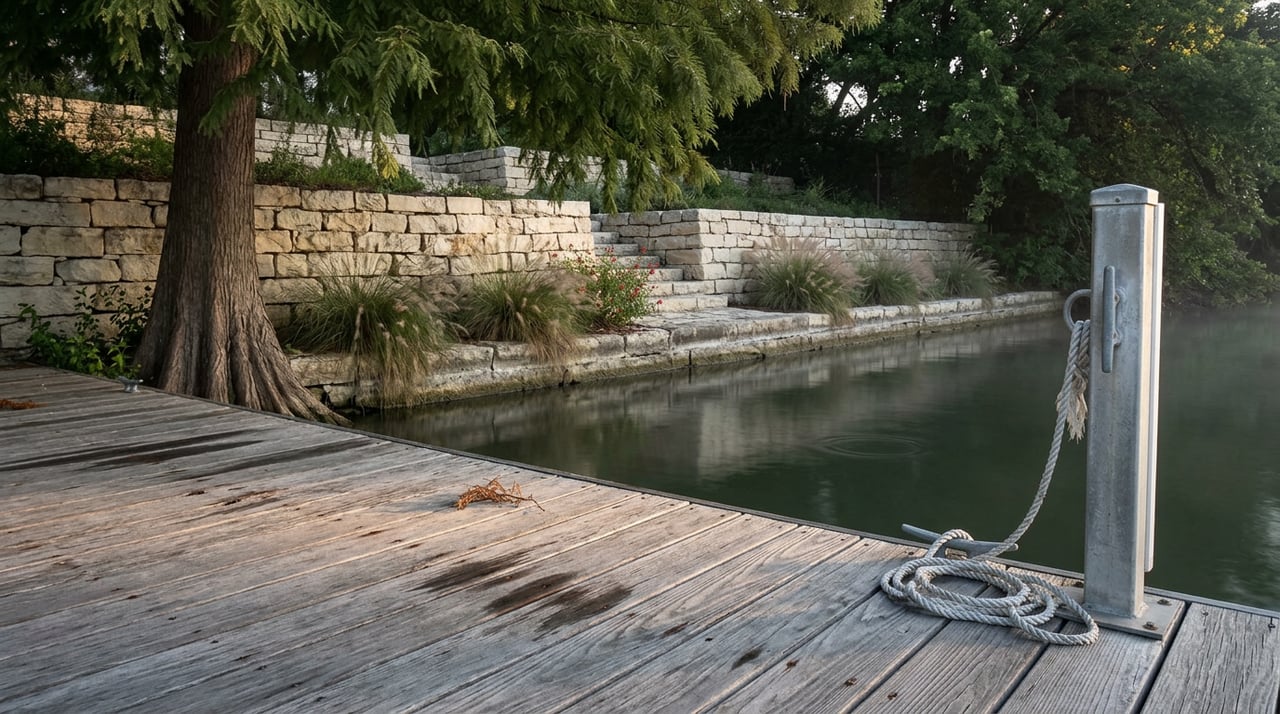
Lake Travis sat at 97.2 percent of its conservation capacity on August 23, 2026, with the surface running just under 680 feet against a full pool of 681 feet. If you're touring waterfront listings in Lakeway this month, the lake looks the way it does in the marketing photos. The dock is floating. The boat launches without a running start across mud. Everything about the property is telling you this is normal.
It isn't. It's the best version of a number that moves more than most buyers realize, and the version you're seeing right now is the one least likely to tell you what you're actually buying.
The number on the listing photo isn't the number that matters
Lake Travis is not a lake in the way a spring-fed swimming hole is a lake. It's a flood-control and water-supply reservoir managed by the Lower Colorado River Authority, built to rise and fall by design as the LCRA balances rainfall, downstream water needs, and flood risk along the Colorado River. Full pool is 681 feet. On September 19, 2023, the lake bottomed out at 629.69 feet, one of the lowest readings in its history. That's a swing of just over 51 feet between full pool and the 2023 low, and roughly 50 feet between that low and where the lake sits today.
Picture that as a vertical distance rather than a statistic. Fifty feet is a four-story building. It's also, depending on where a specific property sits along the shoreline, the difference between a dock floating on open water and a dock resting on exposed limestone a hundred yards from the waterline. A gently sloping lot loses lake access before it loses the view. A steep bluff lot keeps the view but can leave a dock hanging well above dry ground when the lake pulls back.
Here's the part that matters for anyone shopping right now: at 97.2 percent full, you cannot see any of that risk in person. The listing photos, the showing, the drive-by, all of it shows you the lake at its most reassuring. The only way to see the other 50 feet is to go looking for it on purpose.
Reference point | Elevation | Date |
|---|---|---|
Full pool | 681 ft | Design maximum |
Current level | ~679.8 ft | August 2026 |
Historic low | 629.69 ft | September 19, 2023 |
What a permit actually promises you, and what it doesn't
Buyers touring Lakeway waterfront often assume a dock is a fixed feature, the way a garage or a covered porch is fixed. It isn't, and the rules around it are worth understanding before you write an offer, not after.
Under LCRA policy, a private residential dock covering 1,500 square feet of water surface or less does not require a formal LCRA permit. It still has to meet LCRA safety standards covering flotation, lighting, anchoring, and distance from shore, and those standards apply to every dock on the lake regardless of size. Larger structures, mainly commercial marinas and community facilities, need a formal permit under the Highland Lakes Marina Ordinance, which LCRA updated in 2023.
The detail that catches people off guard isn't the permit threshold. It's submerged land ownership.
None of this shows up in a walkthrough. It shows up in the deed, the HOA covenants, and a direct conversation with LCRA about that specific parcel's history.
The marina alternative, and its own catch
Not every buyer who wants lake access needs a private dock, and Lakeway has a real answer for that. Rough Hollow Yacht Club and Marina, on the south shore, is a private, members-only facility with more than 294 boat and jet ski slips, a dual-car tram down to the water, a fuel dock with pump-out service, member lockers, and complimentary kayaks and paddleboards. Beyond the marina itself, members have access to a fitness center, a resort-style infinity pool, and a 2,700-square-foot event pavilion, and the onsite Canyon Grille gives residents a place to eat lakeside without leaving the community. Lakeway Marina, elsewhere on the south shore, has been putting boats in the water since the 1960s, long enough to outlast several cycles of drought and flood pool.
The tradeoff is real and worth saying plainly. A marina slip solves the elevation problem, since a marina channel is engineered and dredged in ways a private cove often isn't, but access depends on the marina rather than the lot itself. For a buyer choosing between a private-dock lot with elevation risk and a marina-access home, that's a genuine tradeoff, not a clear winner.
Why Lakeway's median price refuses to sit still
If you've been comparing Lakeway numbers across different sites this year, you've probably noticed they don't agree. Public trackers have reported Lakeway medians anywhere from the mid $700,000s to the high $840,000s over various windows in 2026, with days on market estimates ranging from under a month to well over three, depending on the source and the exact period measured. Price-cut rates tell a similarly split story, with some datasets showing the majority of listings taking at least one reduction and others showing a much smaller share.
That spread isn't a data quality problem so much as a description of what's actually happening on the ground. Lakeway is not one market right now. It's several markets wearing the same zip code. True lakefront lots with usable, dock-eligible frontage are scarce and have continued to command real premiums, with waterfront generally pricing well above comparable inland homes. Marina-access and lake-view properties, which carry none of the elevation risk, are competing more directly with inland Lakeway inventory on price and days on market. Aging 1990s and early 2000s homes in some neighborhoods are sitting longer next to move-in-ready new construction. Blend all of that into a single median and you get a number that jumps around depending on which slice of inventory happened to close that month.
For a buyer, the practical takeaway is to stop asking "what's the Lakeway median" and start asking which segment a specific listing actually belongs to. A dock-eligible lakefront home, a marina-access home, and a view-only home two streets back from the water are not the same asset, and treating them as comparable because they share a city name will cost you leverage at the negotiating table.
How to evaluate a Lakeway waterfront listing this fall
- Ask for the lake level history for that specific shoreline position, not just the current photos, and picture the property at 630 feet, not just 680.
- Review the property's records for information about the submerged land in front of the lot before the option period ends.
- If a dock exists, ask for its documentation. Confirm whether it falls under the 1,500-square-foot no-permit threshold or whether it required a formal LCRA permit, and request any approval letters if one exists.
- If marina access matters to your decision, contact Rough Hollow Yacht Club and Marina or Lakeway Marina directly to ask about current slip availability rather than assuming access comes with the home.
- Compare the listing against homes in its actual segment, lakefront, marina-access, or view-only, rather than against a citywide median that blends all three.
A few questions worth asking before you tour
Does a full lake mean the dock risk is gone for good? No. The lake's operating range is roughly 50 feet between full pool and its 2023 low, and a full reading in August 2026 describes conditions that day, not a permanent state.
Do all Lakeway waterfront homes have a legal, usable dock? Not automatically. Check the property's records and confirm the status of any dock before relying on it.
Is a marina membership a substitute for a private dock? For many buyers, yes, but marina access is different from having a private dock on the property.
Waterfront math in Lakeway rewards buyers who look past the photo and toward the fifty feet the photo doesn't show. If you're weighing a specific shoreline lot, a marina-access home, or how those two paths compare against your budget and timeline, Scott Pate can walk the property, the deed, and the current lake data with you before you write an offer. Schedule a private consultation to start that conversation. If you're thinking about buying a home in Central Texas, my Austin Real Estate Guide is extremely useful to assist in your search.
This article is general information, not legal, tax or financial advice. Consult a qualified professional about your situation.